Content briefs took too long.
Manual research was eating 3-4 hours per brief with no scalability.
Creating comprehensive content briefs meant hours of manual work: keyword research, competitor analysis, outline building. For each brief, I'd spend 3-4 hours researching before a single word was written.
The Manual Process
- Keyword Research: Find target keywords, cluster semantically related terms, map search intent
- Competitor Analysis: Review top-ranking content, extract structural patterns and topic coverage
- Outline Generation: Structure headings, identify content gaps, plan narrative flow
- Brief Assembly: Format everything in Google Docs with metadata and strategic notes
The process was consistent and repeatable — perfect for automation.
Automate research. Amplify strategy.
A Make.com workflow that handles the research-to-brief pipeline.
I built a Make.com workflow that transforms simple inputs (keyword, audience, funnel stage) into publication-ready briefs in Google Docs. My role shifted from researcher to reviewer — verifying relevance, refining angles, ensuring brand alignment.
The automation executes my SEO methodology at scale, while I focus on strategic decisions that differentiate content.
Why Make.com?
Higher token limits. GPT-based automations hit API restrictions when processing competitor content and generating 3000+ word outlines. Make.com's limits let me build a single-flow system instead of stitching together partial workflows.
Why Google Workspace?
Zero adoption friction. The output looks identical to manually created briefs — no learning curve, no format adjustments for internal teams.
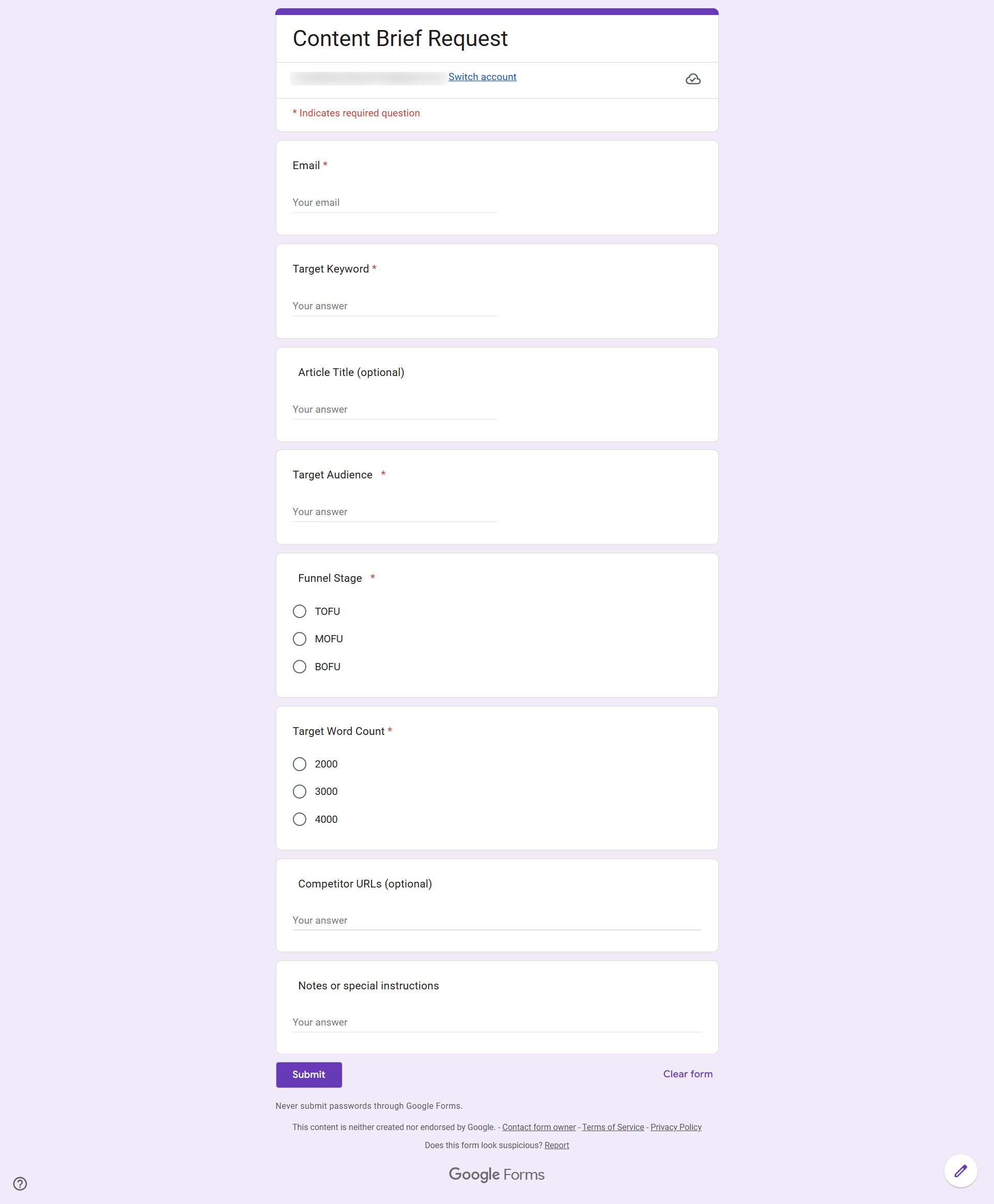
Simple form collecting target keyword, audience, funnel stage, word count, and competitor URLs
The Architecture
(Keyword, Audience, Funnel Stage, Competitors)
(Research, Analysis, Generation)
(Formatted Brief)
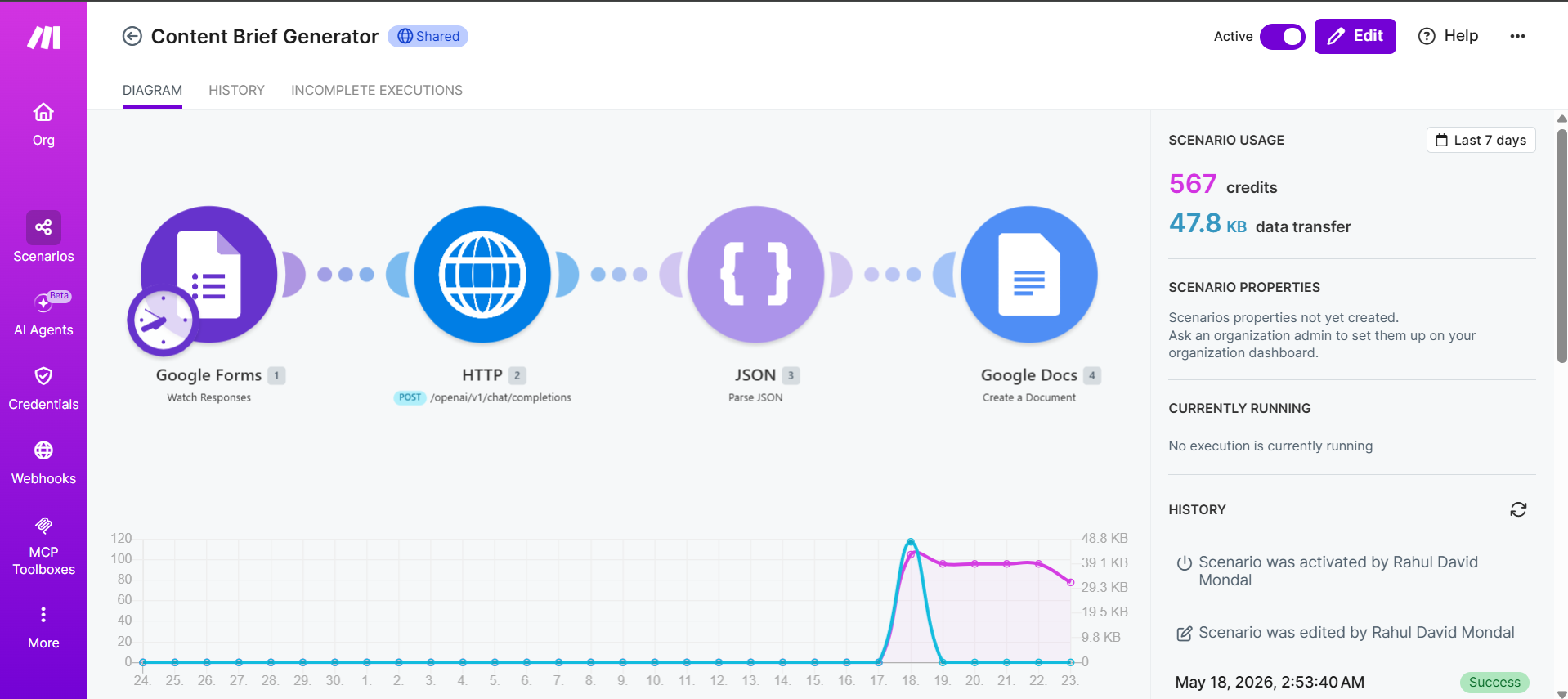
Four-module workflow: Google Forms trigger → HTTP POST to OpenAI → JSON parsing → Google Docs creation. The workflow has processed 567 credits over the last 7 days with 47.8 KB data transfer.
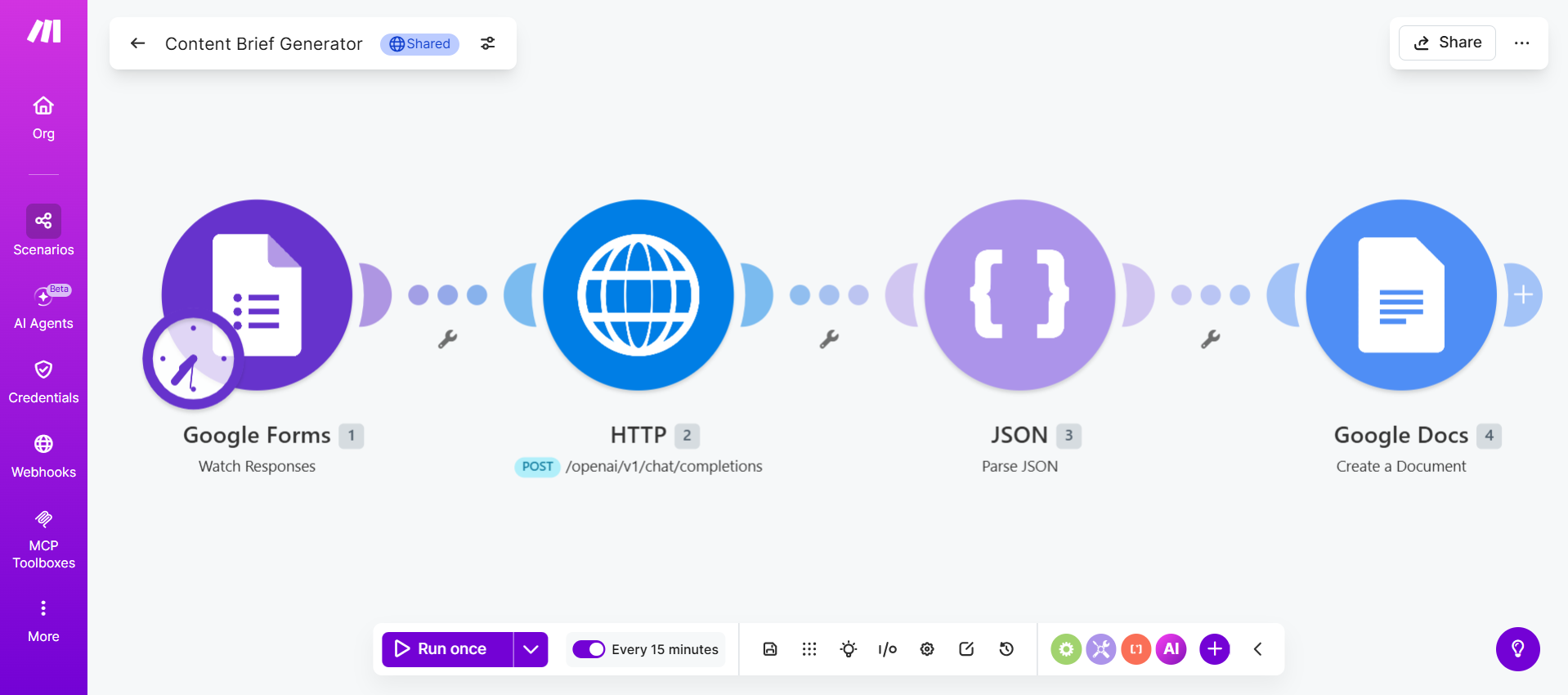
Edit mode showing the detailed configuration of each module. The workflow can run on-demand or on a 15-minute schedule.
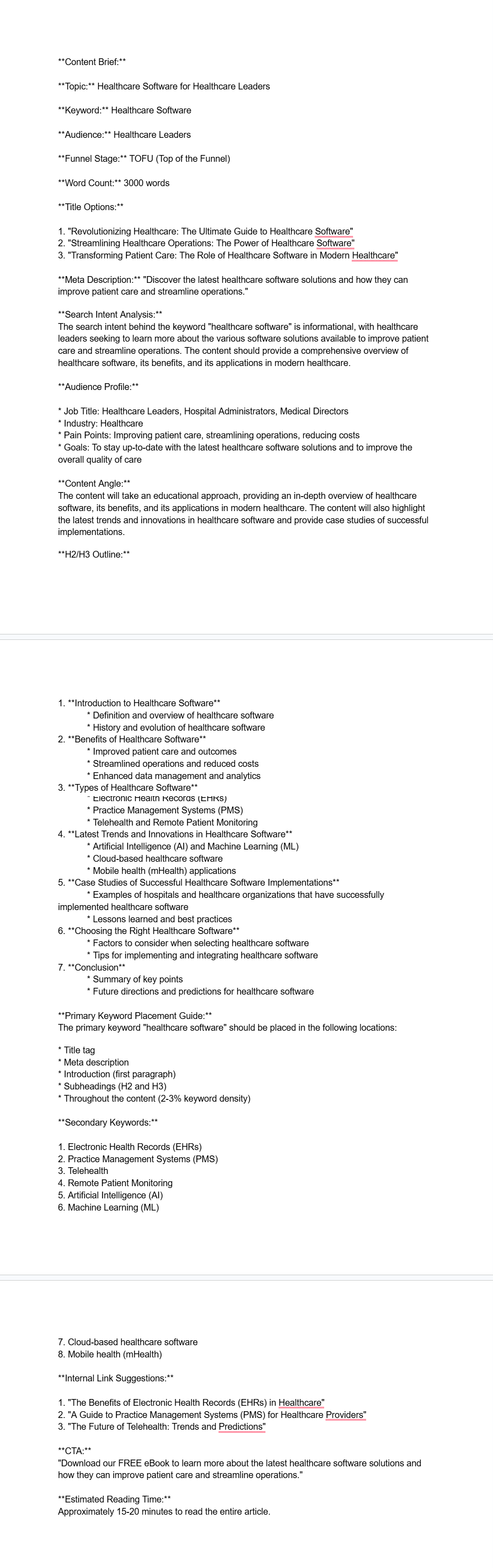
Comprehensive brief with SEO metadata, keyword lists, structured outline, and strategic guidance
Where I Added Value
System prompt design. The entire GPT behavior — outline structure, keyword prioritization, TOFU/MOFU/BOFU balance — came from my SEO experience. The automation executes my methodology at scale.
Input design. The form fields reflect what matters for content planning: audience, intent, competitive context. Balanced simplicity with strategic depth.
JSON schema. Used Claude to structure the output format for consistent Google Docs integration.
Tools Used
Speed without sacrificing quality.
Scalability without losing control.
The automation doesn't replace strategic thinking — it amplifies it. By removing 3+ hours of manual research per brief, I focus on decisions that differentiate content: competitive positioning, audience nuance, brand alignment.
What I Still Do
- Verify keyword data (volume, difficulty, intent)
- Review outline for brand voice alignment
- Adjust competitive angles based on positioning
- Add custom insights requiring industry knowledge
What the Automation Handles
- Keyword research and clustering
- Competitor content analysis
- Outline structure generation
- Meta description + SEO title creation
- Google Docs formatting
Real-World Performance
First production use: Quixta (Healthcare Software vertical)
Generated a 3000-word brief for "Healthcare Software for Healthcare Leaders" (TOFU intent) with keywords, competitor analysis, and structured outline.
Review time: 5 minutes. Verified keyword relevance, confirmed outline matched content calendar, approved for writer.
Result: Brief was indistinguishable from manual work. Writer followed without questions. Article ranked within 4 weeks.
The Bigger Picture
This isn't just about briefs. It's proof of concept for AI-enabled SEO operations.
The same principles apply to automated meta descriptions, batch keyword clustering, competitor tracking alerts, and internal linking suggestions.
I validated a methodology for building scalable, AI-augmented content workflows.